HSK1 Week 1, Part 1: Personal / Short Answers in Mandarin
This is Week 1 of my HSK1 → HSK6 in 6 months challenge. In Part 1, I answer 6 speaking questions completely in Mandarin, using HSK1 words and short sentences.
Watch the video, then use the transcript below to read along and practice out loud.
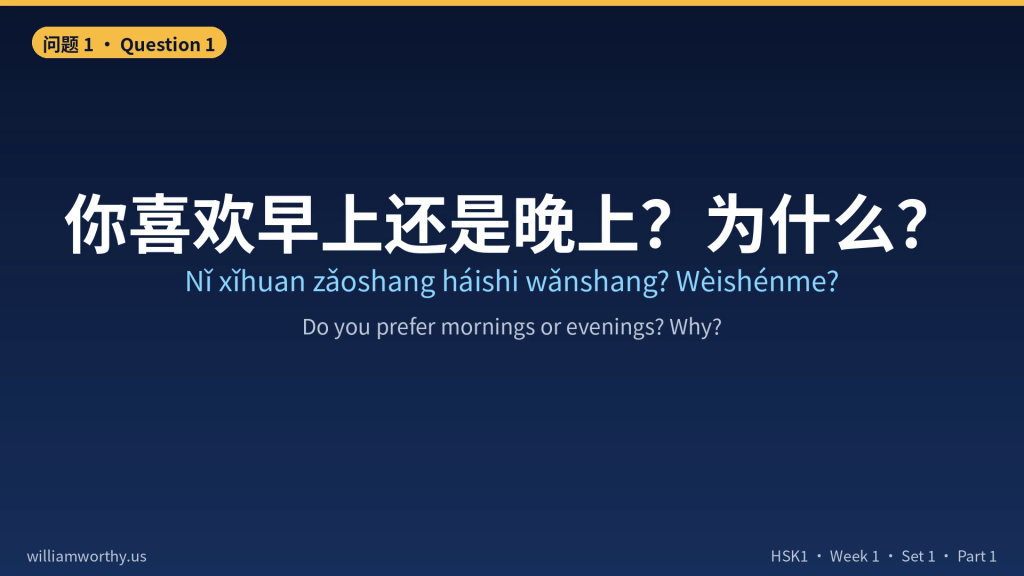
Q1. Do you prefer mornings or evenings? Why?
你喜欢早上还是晚上?为什么?
Nǐ xǐhuan zǎoshang háishi wǎnshang? Wèishénme?
- 我喜欢早上。
Wǒ xǐhuan zǎoshang.
I like mornings. - 早上很好。
Zǎoshang hěn hǎo.
Mornings are nice. - 我早上喝咖啡。
Wǒ zǎoshang hē kāfēi.
In the morning I drink coffee. - 我早上学习中文。
Wǒ zǎoshang xuéxí Zhōngwén.
In the morning I study Chinese. - 早上电话不多。
Zǎoshang diànhuà bù duō.
There aren't many phone calls in the morning. - 晚上我很累。
Wǎnshang wǒ hěn lèi.
In the evening I'm very tired. - 所以我喜欢早上。
Suǒyǐ wǒ xǐhuan zǎoshang.
So I like mornings.
Key words: 早上 (zǎoshang, morning), 晚上 (wǎnshang, evening), 喜欢 (xǐhuan, to like), 为什么 (wèishénme, why), 咖啡 (kāfēi, coffee), 累 (lèi, tired)
Q2. What type of music do you listen to most often?
你常常听什么音乐?
Nǐ chángcháng tīng shénme yīnyuè?
- 我很喜欢听音乐。
Wǒ hěn xǐhuan tīng yīnyuè.
I really like listening to music. - 我开车的时候听音乐。
Wǒ kāichē de shíhou tīng yīnyuè.
I listen to music when I drive. - 我常常听美国的老歌。
Wǒ chángcháng tīng Měiguó de lǎo gē.
I often listen to old American songs. - 现在我也听中文歌。
Xiànzài wǒ yě tīng Zhōngwén gē.
Now I also listen to Chinese songs. - 中文歌很好听。
Zhōngwén gē hěn hǎotīng.
Chinese songs sound great. - 听中文歌,我可以学中文。
Tīng Zhōngwén gē, wǒ kěyǐ xué Zhōngwén.
Listening to Chinese songs, I can learn Chinese.
Key words: 常常 (chángcháng, often), 听 (tīng, to listen), 音乐 (yīnyuè, music), 开车 (kāichē, to drive), 时候 (shíhou, time / when), 好听 (hǎotīng, nice to hear)
Q3. How do you usually relax after a busy day?
忙了一天以后,你怎么休息?
Máng le yìtiān yǐhòu, nǐ zěnme xiūxi?
- 我的工作很忙。
Wǒ de gōngzuò hěn máng.
My work is very busy. - 回家以后,我想休息。
Huí jiā yǐhòu, wǒ xiǎng xiūxi.
After I get home, I want to rest. - 我喝一杯茶。
Wǒ hē yìbēi chá.
I drink a cup of tea. - 我看电视。
Wǒ kàn diànshì.
I watch TV. - 有时候我看中国电影。
Yǒushíhou wǒ kàn Zhōngguó diànyǐng.
Sometimes I watch Chinese movies. - 我也和家人说说话。
Wǒ yě hé jiārén shuō shuōhuà.
I also chat with my family. - 然后我睡觉。
Ránhòu wǒ shuìjiào.
Then I go to sleep.
Key words: 忙 (máng, busy), 以后 (yǐhòu, after), 休息 (xiūxi, to rest), 茶 (chá, tea), 电视 (diànshì, TV), 电影 (diànyǐng, movie), 睡觉 (shuìjiào, to sleep)
Q4. Do you enjoy cooking? Why or why not?
你喜欢做饭吗?为什么?
Nǐ xǐhuan zuòfàn ma? Wèishénme?
- 我喜欢做饭。
Wǒ xǐhuan zuòfàn.
I like cooking. - 可是我做的饭不太好吃。
Kěshì wǒ zuò de fàn bú tài hǎochī.
But the food I make isn't very tasty. - 哈哈!
Hāhā!
Haha! - 我很喜欢吃中国菜。
Wǒ hěn xǐhuan chī Zhōngguó cài.
I really like eating Chinese food. - 我也喜欢吃泰国菜。
Wǒ yě xǐhuan chī Tàiguó cài.
I also like eating Thai food. - 我想学做中国菜。
Wǒ xiǎng xué zuò Zhōngguó cài.
I want to learn to cook Chinese food. - 在家做饭很好,也不贵。
Zài jiā zuòfàn hěn hǎo, yě bú guì.
Cooking at home is nice, and it's not expensive.
Key words: 做饭 (zuòfàn, to cook), 可是 (kěshì, but), 好吃 (hǎochī, tasty), 菜 (cài, dish / food), 在家 (zài jiā, at home), 贵 (guì, expensive)
Q5. How do you normally get around your city?
在你住的城市,你常常怎么去别的地方?
Zài nǐ zhù de chéngshì, nǐ chángcháng zěnme qù biéde dìfang?
- 我住在美国佛罗里达的奥卡拉。
Wǒ zhù zài Měiguó Fúluólǐdá de Àokǎlā.
I live in Ocala, Florida, in the US. - 奥卡拉不太大。
Àokǎlā bú tài dà.
Ocala isn't very big. - 这里公共汽车不多。
Zhèli gōnggòngqìchē bù duō.
There aren't many buses here. - 所以我每天开车。
Suǒyǐ wǒ měitiān kāichē.
So I drive every day. - 我开车去工作。
Wǒ kāichē qù gōngzuò.
I drive to work. - 我也开车带客人去看房子。
Wǒ yě kāichē dài kèrén qù kàn fángzi.
I also drive clients to see houses. - 我很喜欢开车。
Wǒ hěn xǐhuan kāichē.
I really like driving.
Key words: 住 (zhù, to live), 怎么 (zěnme, how), 开车 (kāichē, to drive), 工作 (gōngzuò, work / job), 客人 (kèrén, guest / client), 房子 (fángzi, house)
Q6. What kinds of apps do you use every day?
你每天用什么手机App?
Nǐ měitiān yòng shénme shǒujī App?
- 我每天用很多App。
Wǒ měitiān yòng hěn duō App.
I use lots of apps every day. - 我用X和Facebook。
Wǒ yòng X hé Facebook.
I use X and Facebook. - 开车的时候,我用地图App。
Kāichē de shíhou, wǒ yòng dìtú App.
When I drive, I use a maps app. - 我也用App学中文。
Wǒ yě yòng App xué Zhōngwén.
I also use apps to learn Chinese. - 我每天学几个新的汉字。
Wǒ měitiān xué jǐgè xīn de hànzì.
I learn a few new characters every day. - 我的工作也要用手机和电脑。
Wǒ de gōngzuò yě yào yòng shǒujī hé diànnǎo.
My work also needs a phone and a computer.
Key words: 每天 (měitiān, every day), 用 (yòng, to use), 手机 (shǒujī, cell phone), 汉字 (hànzì, Chinese character), 电脑 (diànnǎo, computer), 新 (xīn, new)
Want to follow along? New sets go up every Wednesday. 下个星期见!(See you next week!)