Why Off-Page SEO Matters for Local Businesses (and What It Really Means)
Most business owners I talk to in Ocala have spent real money on their website. New design, new photos, maybe a few service pages. Then they wait for the phone to ring, and it doesn’t ring much more than before. The site isn’t the problem most of the time. The problem is that nobody outside the site is talking about the business yet.
That outside part is what people call off-page SEO. This post kicks off a short series where I break down each piece of it, one at a time, in plain language, so you can decide what is worth your time and what is worth paying someone like me to handle.
What is off-page SEO?
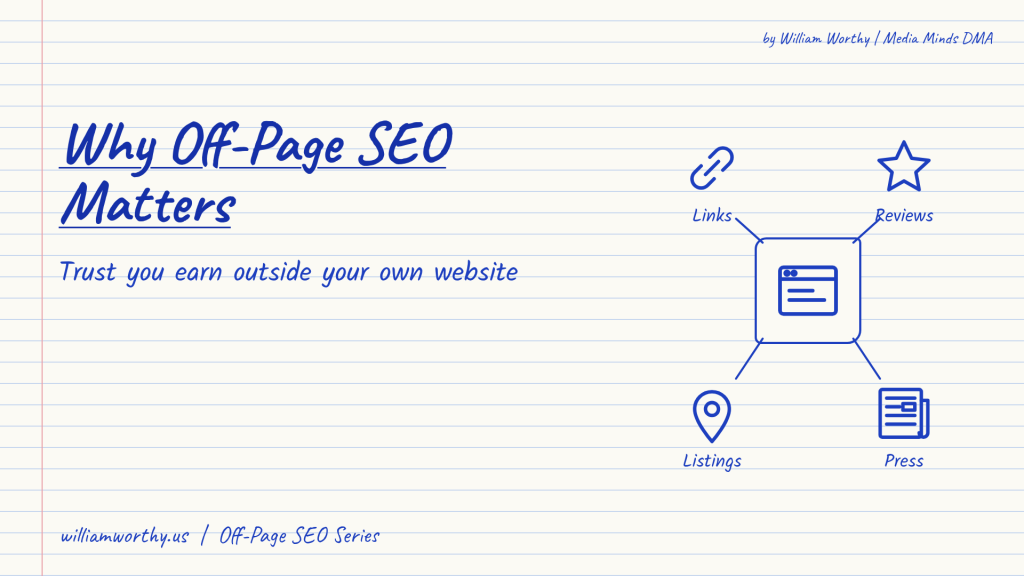
Off-page SEO is the work you do outside your own website to show search engines and people that your business is real, known and trusted. It covers links from other sites, mentions of your business name, reviews, directory listings, press and community activity. Your website says what you do. Off-page signals show that others agree.
On-page SEO is the stuff you control directly: your titles, your content, your page speed, how your services are described. Off-page SEO is what happens on everyone else’s property. You can influence it, but you can’t fake it for long, and Google spends a lot of effort making sure of that.
Why off-page SEO is important
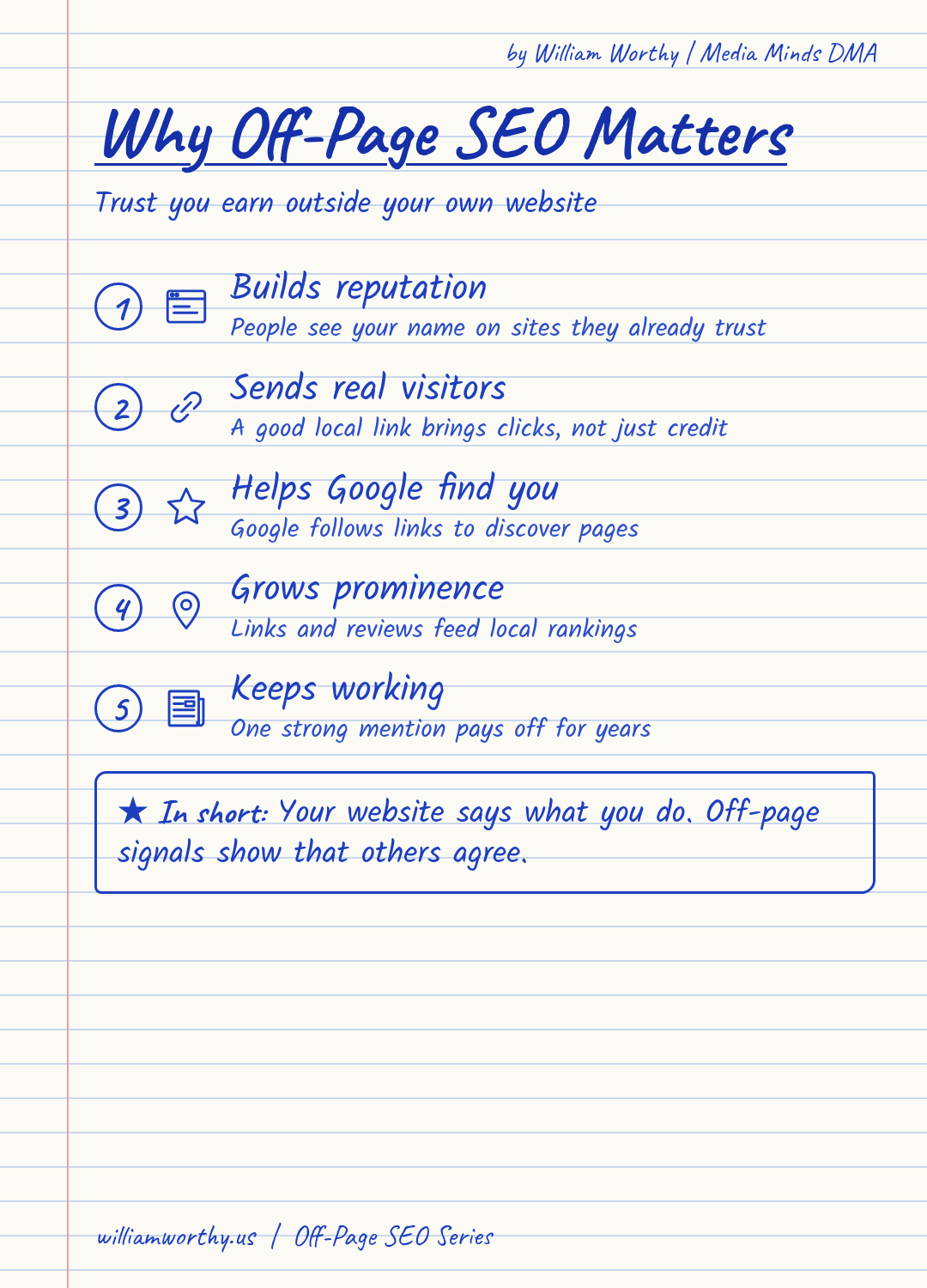
Google says it finds many new pages by following links from pages it already knows, and its local ranking help page names prominence as a factor, based partly on how many sites link to you and how many reviews you have. Off-page work is how a business earns that prominence instead of just claiming it.
You don’t have to take my word for it. Google’s own help page on local ranking says local results are mainly based on relevance, distance and prominence. On prominence, it says the factor is based on info like how many websites link to your business and how many reviews you have. Google’s explanation of how Search works also describes finding new pages by following links from pages it already knows.
In practice, here is what good off-page work does for a local business:
- It builds reputation. When people see your name on other trusted sites, you stop being a stranger.
- It sends referral traffic. A link in a local news story or a chamber listing can bring real visitors, not just ranking credit.
- It helps Google discover and understand you. Mentions and links connect your business to a place and a topic.
- It builds relationships. Most good links come from people who know you, not from software.
- It compounds over time. One strong mention keeps working for years.
The 8 off-page activities I will cover
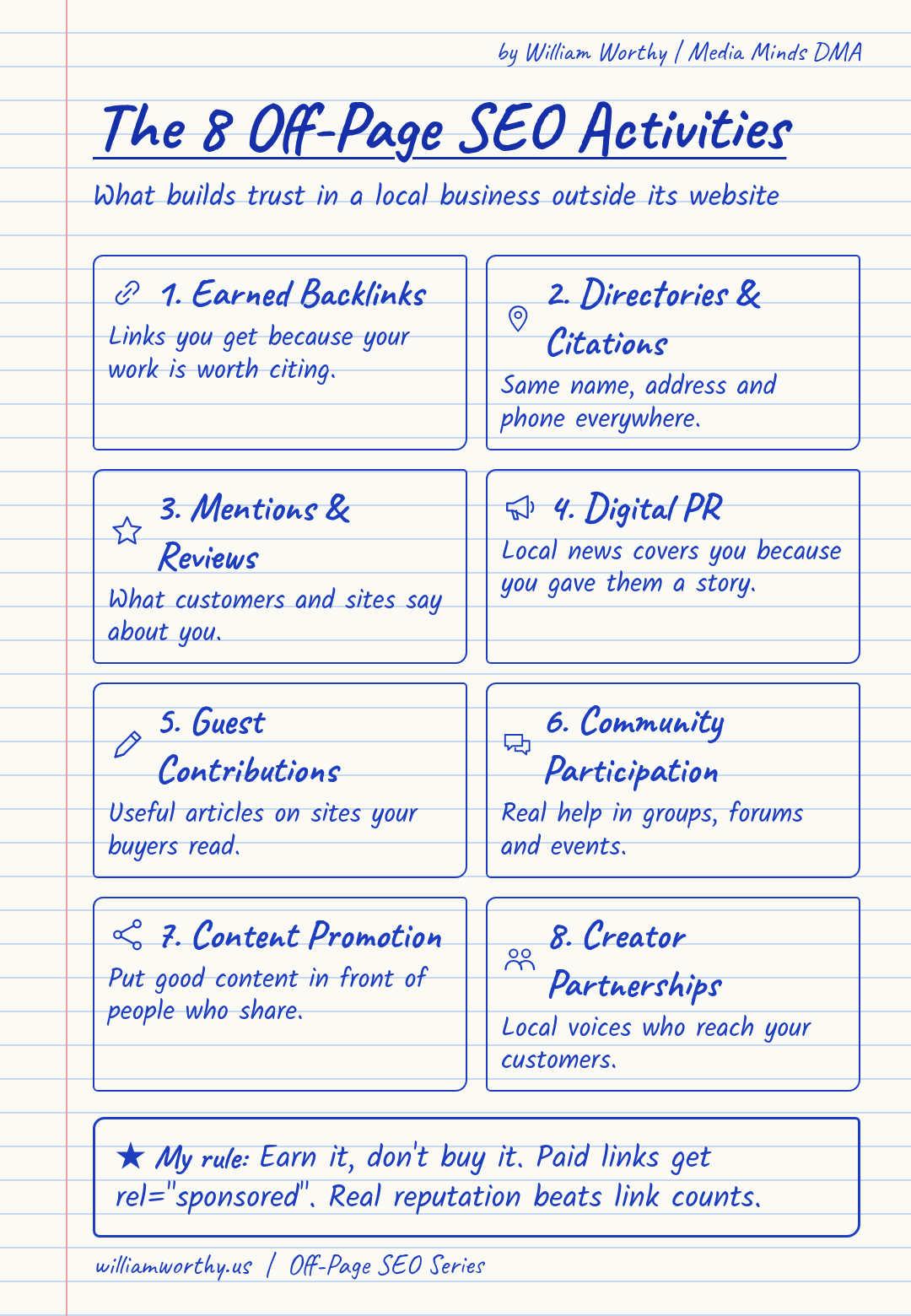
There are eight activities that do most of the work: earned backlinks, business directories and citations, brand mentions and reviews, digital PR, guest contributions, community participation, content promotion, and creator partnerships. Each one gets its own post in this series, with what works, what to skip and what it costs.
Here is the order I’m publishing them in, and why:
- Earned backlinks. The foundation. What makes a link worth having and how local businesses actually earn them.
- Business directories and local citations. The fastest win for most local businesses, because it is about accuracy.
- Brand mentions and reputation. Reviews and unlinked mentions, and how to handle the bad ones.
- Digital PR. Getting covered by local media because you gave them something worth covering.
- Guest contributions. Writing for other sites the right way, without stepping into link spam.
- Community participation. Forums, Facebook groups, Reddit and real-world events.
- Content promotion. Getting the content you already paid for in front of people who might link to it.
- Creator and influencer relationships. Working with local creators, and the disclosure rules that come with it.
The series wraps up with a best practices post covering what to avoid, including paid links, automated link tools and link swaps.
What off-page SEO is not
Off-page SEO is not buying a package of 500 backlinks, blasting your link into forums or trading links with every site that emails you. Google lists those exact tactics as link spam. They can get your site ranked lower or removed, and the money is gone either way.
Google’s spam policies define link spam as creating links to or from a site primarily to manipulate search rankings. The examples include buying or selling links for ranking purposes, excessive link exchanges, using automated programs to create links, and low-quality directory or bookmark links. If someone is selling you a guaranteed number of links per month, read that page before you pay them.
I also want to be straight about this: off-page SEO doesn’t replace a good website. If your service pages are thin, links will just send people to a page that doesn’t convert. The two work together.
Where a local business should start
Start with what you already own: make your business name, address and phone number match everywhere, claim the major directories, and ask happy customers for reviews. Then look at who already mentions you and who should. That inventory tells you which of the eight activities will pay off first.
When I take on a new local client, my first pass usually looks like this:
- Check the Google Business Profile for accuracy and completeness, following Google’s guidelines for representing your business.
- Pull every directory listing I can find and note mismatched names, old phone numbers and old addresses.
- Look at who links to the site today, and who links to the top three competitors.
- Search the business name to find mentions that don’t link back yet.
- Write down the local organizations, suppliers and partners that already know the owner.
That fifth step is the one most people skip, and it is usually where the best links are hiding.
Want me to look at yours?
If you want to know where your business stands before you spend anything, start with my free Marketing Report. It shows how your business shows up online today, so we can talk about what to fix first based on your own data instead of guesses.
Questions I get about this
Is off-page SEO still important in 2026?
Yes. Google still names links and reviews as part of local prominence on its local ranking help page, and it still uses links to discover pages. What changed is that manipulative links are easier for Google to spot and ignore.
Can I do off-page SEO myself?
Much of it, yes. Fixing your directory listings, asking for reviews and joining local groups takes time more than skill. Where people get stuck is finding link and press opportunities and staying clear of tactics Google treats as spam.
How is off-page SEO different from on-page SEO?
On-page SEO is the work on your own site, like content, titles and page speed. Off-page SEO is the reputation you earn on other sites, like links, mentions, reviews and listings.