Earned Backlinks for Local Businesses: How to Get Links Google Actually Trusts
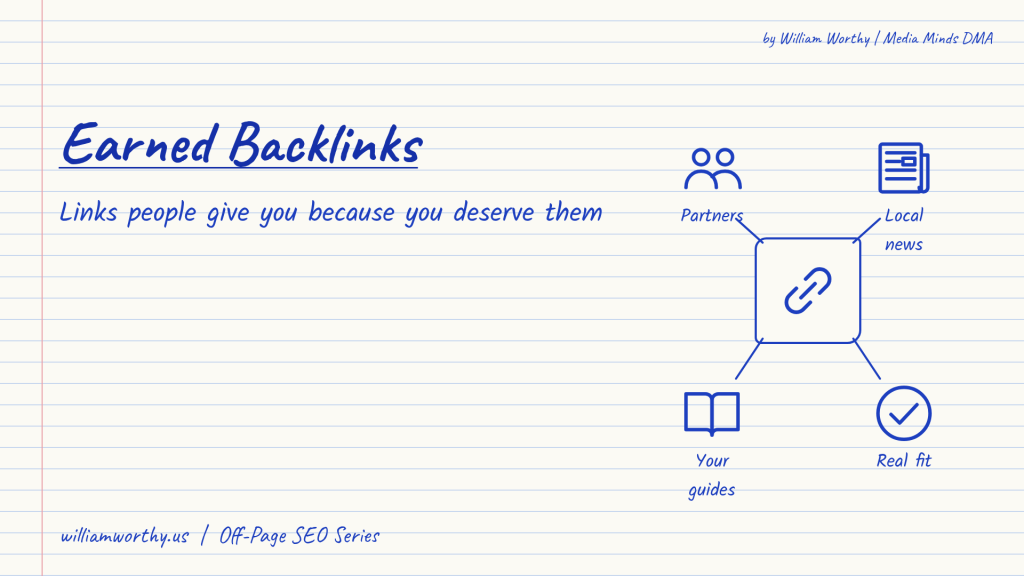
When a business owner asks me about backlinks, the question is usually “how many do I need?” That is the wrong question. One link from the Ocala chamber, a local news story or a supplier you’ve worked with for ten years is worth more than a stack of links from sites nobody reads. This post is about the kind of links you earn, where they come from for a local business, and how I go after them for clients.
If you are new to this series, start with my post on why off-page SEO matters. It explains how links fit into the bigger picture.
What is an earned backlink?
An earned backlink is a link another site gives you because your business, page or information is genuinely worth pointing to. Nobody was paid, nothing was traded and no software placed it. The site owner chose to link because it helps their own readers, which is exactly the kind of link Google’s policies are built to reward.
Compare that with what Google’s link spam policy describes: links created primarily to manipulate rankings. That includes paying for links, trading products or services for links, excessive “link to me and I’ll link to you” swaps, and links made with automated programs. An earned link is the opposite. It exists because someone decided your page was useful.
Why earned links matter more than link counts
Google uses links to discover pages and, for local results, names links as part of a business’s prominence. But links that look manipulative can be ignored or cause trouble. A few relevant links from sites your customers trust do more for you than hundreds of random ones.
Google’s local ranking help page lists prominence as one of the main local factors and says it is based on info like how many websites link to your business. Read that alongside the spam policy and the message is clear: links help, but only the kind a real person would give you.
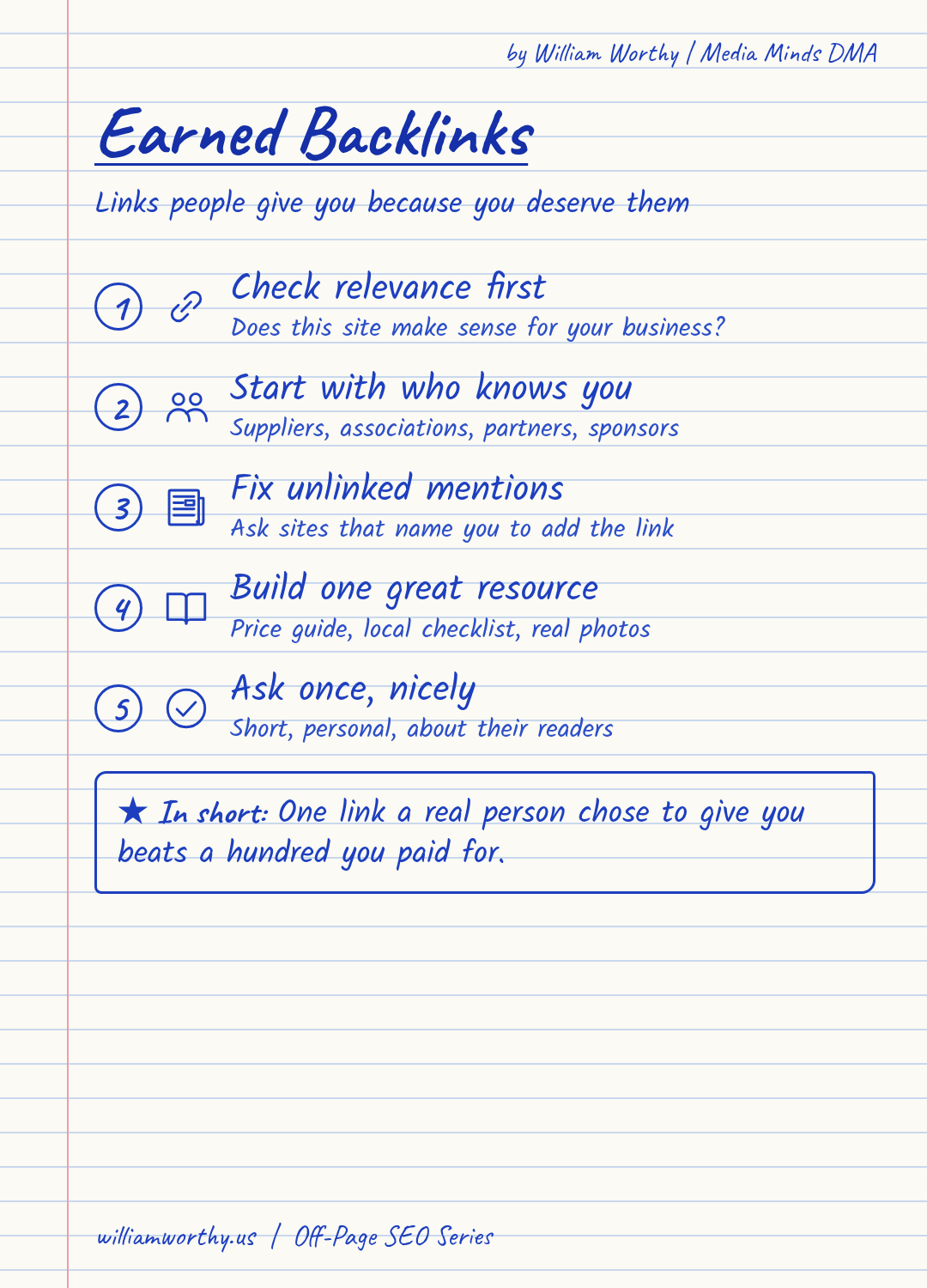
When I judge a possible link, I ask three questions:
- Is the site relevant? A home builder linking to a roofer makes sense. A casino blog linking to a roofer does not.
- Do real people read it? If the site has no audience, the link won’t send anyone.
- Would I want this link if Google didn’t exist? If the answer is yes, it’s usually a good one.
Where local businesses actually earn links
Most local links come from relationships you already have: suppliers, partners, associations, sponsors, local media and customers with websites. The work is finding where you are already mentioned or connected and making it easy for those sites to link to a page that deserves it.
Here is the list I work through with a new client:
- Suppliers and manufacturers. Many have “where to buy” or “certified installer” pages. If you carry their product or hold their certification, ask to be listed.
- Trade and professional associations. Membership directories often link to member sites.
- Local organizations you support. If you sponsor a youth team or a charity event, the thank-you page is a natural place for a link. Keep in mind that Google treats paid placements as advertising, so if the link is part of a paid sponsorship package, it should carry a rel=”sponsored” attribute. The visibility still helps you.
- Partners and referral sources. A real estate agent who sends you clients may already have a “trusted vendors” page.
- Unlinked mentions. Search your business name in quotes. When a site mentions you without linking, a polite note asking them to add the link often works.
- Local news and events. I cover this in the digital PR post coming up in this series.
Give people something worth linking to
Sites link to pages that help their readers: a clear price guide, a local resource list, original photos, a tool or real data from your own work. If your site only has a home page and a contact form, there is nothing to link to, so building one strong resource usually comes before outreach.
Some ideas that fit local service businesses:
- A cost guide based on the jobs you actually quote, with your real ranges.
- A seasonal checklist, like hurricane prep for homeowners in Marion County.
- A plain-language explainer of a local permit or inspection process.
- A photo library of your own projects that local bloggers can use with credit.
The point is to make something that answers a question better than anyone else in your area. Google’s guidance on helpful, reliable, people-first content is a good check before you publish.
How I ask for links without sounding like spam
Keep the request short, personal and about their readers. Mention the exact page where a link would help and why. Don’t offer money or a link swap in return. If they say no or don’t answer, move on. One good note to the right person beats a hundred templates.
A note I’d send looks something like this: “Hi Sarah, I saw your vendor list for new homeowners. We’ve installed water filtration for about a dozen of your buyers. If it’s useful, our guide to Ocala water hardness could help them too. Here’s the link.” That’s it. No pressure, no trade.
What I won’t do
I won’t buy links, run automated link tools or set up link swap schemes for clients. Those tactics are named directly in Google’s spam policies, and cleaning up after them costs more than doing it right the first time. If you inherited links like that, my post on toxic link cleanup explains what matters before you pay anyone to fix it. My off-page SEO best practices post covers the full list of what to avoid.
How long earned links take
Earned links build slowly. A single good resource or local story might earn a handful of links over several months, and that is normal. The payoff is that these links tend to stay, keep sending visitors and hold up when Google updates its systems, unlike links bought in bulk.
Find out who links to you now
Before chasing new links, it helps to know what you already have and how you stack up against competitors. My free Marketing Report is a good place to start. It gives us real numbers to plan from.
Questions I get about this
How many backlinks does a local business need?
There is no set number. Google does not publish one, and relevance matters more than count. A handful of links from trusted local and industry sites often does more than hundreds of unrelated ones.
Is it OK to pay for a link?
Paying for ads and sponsorships is normal, but Google says links that are paid for should be marked with rel=”sponsored” or rel=”nofollow”. Paying for links to pass ranking credit is against its spam policies.
Should I ask a site to link to me?
Yes, when there is a real reason, like an existing mention, a partnership or a page that helps their readers. Keep it personal and don’t offer anything in exchange.