AI Content vs Scaled Content Abuse: Will Google Penalize Your Site?

I hear two opposite fears from business owners right now. One group is afraid Google will punish them for using AI to write anything. The other group is publishing hundreds of AI pages a month and hoping for the best. Google’s actual policy sits in a different place than either fear.
Does Google penalize AI content?
Not for being AI. Google’s guidance says it rewards helpful content however it is produced. What its spam policies target is scaled content abuse: many pages made mainly to manipulate rankings rather than help people. That applies to AI, human writers or a mix. The risk is the purpose and quality, not the tool.
What Google actually says
In February 2023 Google published Google Search’s guidance about AI-generated content. The short version: Google focuses on the quality of content, not how it was produced, and using automation mainly to manipulate rankings is a violation of its spam policies.
The policy itself is on Google’s spam policies page. It defines scaled content abuse as many pages generated for the main purpose of manipulating search rankings and not helping users, no matter how they are created.
What David Quaid and Edward Sturm say
David Quaid has made this point several times. In Scaled Content Abuse vs AI Content he says plainly that it is scaled content, not AI content, that gets penalized. He went deeper in The Scaled Content Abuse Penalty and the latest Google Spam Update, and pushed back on the opposite claim in Google and AI Content: Why Neil Patel is Just Wrong.
Edward Sturm’s guest Kristine Schachinger takes a more cautious view in Google’s AI Content-Killing Algorithm Is Coming. And Sturm’s episode on Google’s “content effort” score notes that Google’s Quality Rater Guidelines mention effort more than 100 times. Both point the same way. Low-effort pages at scale are the danger.

Signs your site could be at risk
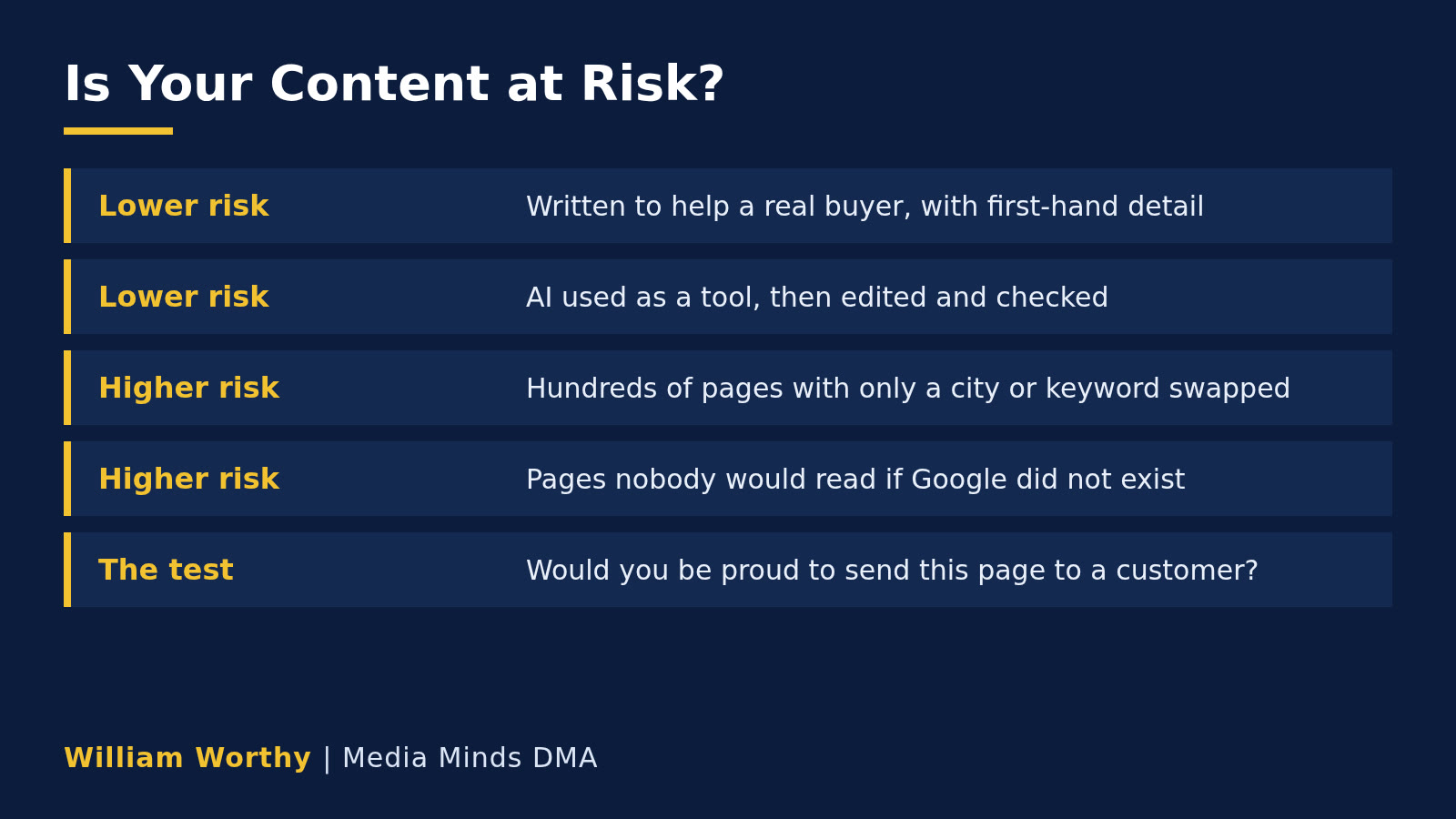
- Hundreds of pages where only the city or keyword changes.
- Pages published faster than anyone could check them.
- Content that restates what already ranks, with nothing new.
- Pages with no clear reader in mind, only a keyword.
- Traffic that rose fast and then dropped hard after a Google update.
What to do if that sounds like your site
- Find the thin pages. Use Search Console to spot pages with impressions but no clicks, or no impressions at all.
- Merge or remove. Combine near-duplicates into one strong page and redirect the rest.
- Add real experience. Photos, prices, local details and answers only you can give.
- Slow down. Fewer, better pages beat more pages.
Google’s guide to creating helpful, reliable, people-first content has a self-check list that is worth going through page by page.
How I use AI in my own work
I do use AI tools in my work. I use them for research, outlines and first drafts. Then I edit, check facts and add what only I know about Ocala, my clients’ industries and the work itself. That is the line I think matters: the tool helps, but a person stands behind every page.
If you want another angle on keeping your site trusted by Google, read about Google Preferred Sources, a way your readers can tell Google they want to see more of your site.
Find out where your site stands
If you are worried your site has crossed the line, my free Marketing Report is a good first step. Get your free Marketing Report, and I will show you how your site shows up in search today.
FAQ
Do I need to label AI content on my site?
Google’s 2023 guidance suggests explaining how content was made where readers would reasonably expect it, but it is not a ranking requirement.
Will one AI-written page hurt my whole site?
A single helpful page is not scaled content abuse. The policy is about many pages made mainly to manipulate rankings.
If you find my posts useful, scroll to the bottom of this page and click Make me preferred on Google. It tells Google you want to see more from williamworthy.us in your results. Here is how Google Preferred Sources works.